
Foreign Ministry Spokesperson Lin Jian’s Regular Press Conference on April 30, 2026
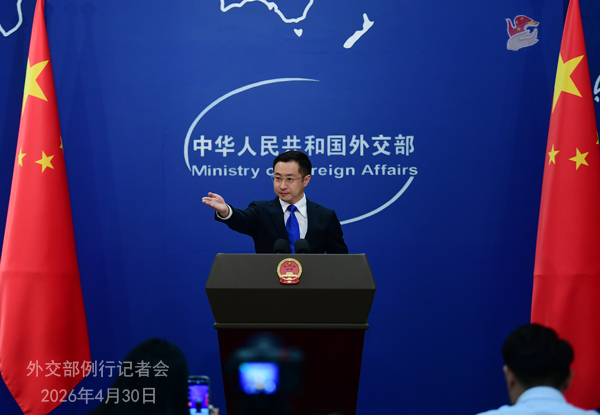
Global Times: It is reported that Japan has decided on a plan to revise the rank titles of the Self-Defense Forces (SDF) and intends to submit a draft bill to the Diet within this year. The overhaul includes reviving military rank titles during WWII, such as “taisho” and “taisa.” A senior official in the Japanese government said that the move aims to create a work environment with a sense of honor and attract and retain SDF members. What’s your comment?
Lin Jian: After WWII, as a defeated nation, Japan was required to disarm its military forces and dismantle its war machine. Several years later, in 1954, when establishing the SDF, Japan chose to name the ranks using numbers and stopped using the military-style ones used in the old army. Many in Japan believe that by adopting a non-military-style rank system, Japan intended to make a clear cut with the wartime military in line with the spirit of the pacifist Constitution. It shows that the rank titles are absolutely not just a technical issue for Japan.
In recent years, however, Japan has been pushing for a more offensive, expansionist, and dangerous defense policy and has torn up its “pacifist” rulebook. Japan’s latest move to reinstate WWII military ranks out of “a sense of honor” is a breach of long-existing rules and will instill a wrong perception. This would also rub salt into the wounds of Japan’s wartime victims. We cannot but ask: Is Japan still indulged in a dream of reviving militarism? What exactly is this “sense of honor” built on?
The rise of neo-militarism in Japan is posing a real threat to world peace and stability. The Chinese people, together with anyone in the world who stand for justice, should stay on high alert and firmly safeguard the outcome of the WWII victory so that the tragedies of history will not repeat themselves.
AFP: Chinese Foreign Minister Wang Yi met with Myanmar’s leader Min Aung Hlaing over the weekend. Can the Foreign Ministry tell us if the detained former leader Aung San Suu Kyi’s detention was discussed during the meeting?
Lin Jian: On Foreign Minister Wang Yi’s visit to Myanmar, relevant readouts have been released. Daw Aung San Suu Kyi is an old friend of China. Her circumstance has always been on our minds. China and Myanmar are friendly neighbors. China supports Myanmar in following a development path suited to its national conditions and supports various parties of Myanmar in realizing more broad-based, robust and sustainable peace and reconciliation.
Hubei Media Group: It’s reported that the Nonpartisan Parliamentary Association for Reconsidering Human Rights Diplomacy convened a meeting at the Diet to discuss the blockade of Lai Ching-te’s trip to Africa and planned to submit a statement to the Japanese government. The statement pointed out that the diplomatic independence of any country shall not be undermined by any coercion. It also demands that the Japanese government play a positive role in protecting the free environment of exchanges between Taiwanese people and their democratic partners. What is your comment?
Lin Jian: There is but one China in the world. Taiwan is an inalienable part of China’s territory. The one-China principle is a prevailing consensus of the international community. China highly commends relevant countries’ concrete actions in upholding the one-China principle and opposing “Taiwan independence” separatist activities, which are fully consistent with international law and basic norms governing international relations.
The Japanese side must not forget that the 1972 Sino-Japanese Joint Statement states that “The Government of Japan recognizes the Government of the People’s Republic of China as the sole legal Government of China. The Government of the People’s Republic of China reiterates that Taiwan is an inalienable part of the territory of the People’s Republic of China. The Government of Japan fully understands and respects this stand of the Government of the People’s Republic of China, and it firmly maintains its stand under Article 8 of the Potsdam Proclamation.” The 1978 Treaty of Peace and Friendship Between China and Japan, ratified by the two countries’ legislatures, affirmed that the principles set out in the 1972 Joint Statement should be strictly observed. Since the two countries normalized relations, the Japanese government has stated on many occasions that the Taiwan question is China’s internal affair. These are legal obligations Japan must fulfill and political commitments it must honor.
As to issues related to foreign policy independence, democracy and human rights, I notice that many people with insight in Japan are reflecting on Japan’s domestic and foreign policies. There are also many discussions on “comfort women,” forced war labor, and other issues left from history, as well as indigenous peoples and minority rights in Japan. Yet some politicians in Japan either keep silent and play deaf to those issues or point fingers on Taiwan which is inherently part of China. Guess they are the only ones who know what its hidden objective is.
China News Service: China will take the rotating presidency of the UN Security Council for May. How will China perform its duty and play its role?
Lin Jian: Starting from May 1, China will hold the rotating presidency of the UN Security Council. As the world is fraught with transformations and turbulence and regional conflicts keep cropping up, the role of the Security Council, which shoulders primary responsibility for the maintenance of international peace and security, has drawn great attention. China attaches great importance to the rotating presidency. We will act in a responsible and constructive spirit and galvanize efforts to enable the Security Council to enhance solidarity and cooperation, remain fair and open, take practical actions, promote political settlement, and earnestly perform its duty mandated by the UN Charter. We look forward to support from the international community and collaboration in advancing the Security Council’s agenda for May, jointly practicing true multilateralism, and make greater contribution to peace and development.
*************************************************
During the May Day holiday, there will be no regular press conference from Friday, May 1 to Tuesday, May 5. The regular press conference will resume on Wednesday, May 6. During this period, questions can be submitted to the Spokesperson’s Office via fax, email or WeChat.